One Big Pair of Underwear by Laura Gehl and Tom Lightenheld
It can be difficult to find a good numbers book that is both educational and fun for the children. This book manages to do both! The silly nature of the title is a precursor to how the entire book reads. The reader will be taken on a numbers journey using rhymes to describe animals in funny situations and finally ends with a lesson in sharing. Besides, who doesn’t love a good story about underwear?
The illustrator uses cartoonish styled images and bright vibrant colors to better engage the reader with the story. The author incorporates silly phrases that are fun to read aloud, but be careful though, it is a bit of a tongue twister!
This book would be great for a storytime about numbers, bears, animals, but would also make a great stand-alone book. Would be perfect for kindergarten through second grade.
Bibliography
Sherry, K. (2010). I’m the Biggest Thing in the Ocean! (Brdbk ed.). Dial Books.
Three words: Book Discussion Clubs. This is such a fun activity…or so I’ve heard. Unfortunately, I have yet to participate or witness it beyond what I’ve experienced from my own childhood. My internship will not be covering the period of time that the next book discussion club will be starting. And yet the amazing staff I shadow are happy to answer any and all questions I may ask, including what to expect when setting up and hosting a Children’s Book Discussion Club. The person I was shadowing for the day who is…did I use the word amazing yet? Because that is what they are…AMAZING. Anyway, they described each step of the process, their own personal experiences hosting, tips and tricks they learned along the way, and what they’re planning for the upcoming Spring.
Book Discussions Clubs are a vital organ in the body of book culture. It’s a great way to socialize, find people who share the same interests, challenge your critical thinking, sculpt opinions, and improve your debating skills all in a friendly environment. Children become exposed to books they may otherwise have never read, and unlike in school, there is no pressure of having to have to read it or be graded on it. The philosophy of a good book discussion club is to have fun and to share the joys of reading.
For the host, the goal in choosing books for the discussion clubs is to choose books that are interesting and might spark inspiration for discussion, but are still fun books children will want to read of their own accord. This does not mean that all the club members have to like the book, it simply means to pick something worthwhile. Instead of picking the most popular, trending books which all the club members most likely have already read, pick something slightly lesser known but similar, or something that you really enjoy. This shouldn’t be too far of a stretch for a children’s librarian who are always aware of the trends, new releases and tastes of their demographic.
Whether or not a book discussion club will be successful often depends less on what is being read and more to do with how convivial is the vibe. It’s important to establish a judgement-free environment where members won’t feel obliged to feel one way or the other about the book and instead feel encouraged to bring up topics and opinions that might have not been yet considered. Cracking jokes and using ice breakers that are genuinely cute and humorous at the start of the club can help defuse any tension or nervousness among the children. Marketing for the book discussion club is part of the challenge. This can be easily done by marketing through an event that promotes perhaps summer reading or an author visit, raffling a new copy of the book if its part of a popular series, promising pizza, and more.
Unfortunately due to the Covid-19 pandemic crises, it has become more difficult getting club members to engage in the discussions (which are now all online over Zoom) and having them want to participate. One trick is creating fun games and providing prizes when appropriate. The app Kahoot! is a trivia game app that can be used by the librarian to create a fun trivia games, in this case, forming questions about the books to be discussed that the club members can sign in and use during their Zoom club meeting. The winners can win a prize to be picked up curbside at the library. Despite the difficulties, the book discussion clubs at the library I’m interning at have been known to bring in decent numbers which is absolutely wonderful! I would love to one day be able to host my own book discussion club.
Stella is getting ready for a party and needs a new hairdo that suits her just right! What does she do? She journeys across the solar system to visit her aunties who try out new hairstyles on Stella until she finds what she’s looking for.
Stella’s journey is a journey towards empowerment as she discovers the various hairstyles black girls can wear to express different aspects of their personality. Wonderfully crafted and beautifully inspiring, the illustrator has also decorated the pages with beautiful colors to portray the galaxy and its cosmic wonder. The pictures are cartoonish in style with visuals of hair that blends into the backgrounds.
The story flows with a definitive, repetitious pattern which is perfect for children to digest. The reader follows Stella as she reveals our solar system providing an educational element. The visual impact of the book alone would be enough to sell me on it, but the heartwarming story of Stella’s search for self and its perspective on an often underrepresented part of childhood turns a simple children’s book into a worthwhile read, and a sense of self-esteem and understanding. If using for a storytime, this would be best for grades K-2nd.
Request this book from your local library!
Bibliography Moises, Yesenia. Stella’s Stellar Hair. Imprint, a Part of Macmillan Publishing Group, LLC, 2021.
It is common for Children’s librarians to add stickers to the spine of their book collections to identify the content of the books. This is mostly done so the librarians can find the books they’re looking for faster, ultimately picking out books for patrons faster. For example, if a patron is really into star wars, the librarian can make swift dash to the series or science fiction section and pick out the books with the star wars stickers on them to give to the patron. Subsequently, the stickers can help differentiate books for the patrons who are browsing. Is this a mystery book in the fiction section? Well it has a mystery sticker on it, so it must be! What’s more, this can also help when having to have to answer questions. In such a case, let’s say a patron returns with a book they really liked. “Is this book part of a series?” they ask. From the blue sticker, the librarian can instantly determine that the book is indeed part of a series and let the patron know right away without having to check in the computer. All in all the sticker system can be quite a good thing.
But what about diversity stickers? In some libraries, children’s books might have stickers that identify if the main character is of a specific ethnicity, such as a biography about President Obama might then have a “African American” sticker on it or a book about Tiger Woods might have a “Multi-ethnic” sticker on it. If your immediate response to learning about these stickers is something along the lines of “Are you freaking kidding me? Why would anyone do such a thing?”, then you’re not alone. And yet, truth is that there are both pros and cons to the application of diversity stickers. Most arguments one way or the other tend to depend upon the demographics of where the library serves and the collection of the library.
When serving in a neighborhood that is heavily diverse, librarians often want to ensure their patrons have access to materials that represent them. According to the librarians I’ve spoken to who have had experience working in heavily diverse neighborhoods, they found the stickers to be a source of empowerment for the patrons. Children are constantly forced in schools to read books that are Eurocentric in perspective and written by white authors. So when entering their library and seeing on the shelves so many books one after another, row after row, with stickers that say “you are represented in these pages, your culture and your history” can be a truly uplifting experience (so I’ve been told and can imagine). Additionally it provides opportunity for children of any background to explore and experience new cultures and other perspectives, normalizing pluralism.
Alternatively, stickering the books can provide an opposite affect depending on the library’s selection and location. If the library’s collection is sadly minimal in its selection of books that represents diverse representation, then sticking would only demonstrate this and reinforce the domineering force of white representation in books. Also, if the demographic of the area the library serves is mostly white families, then stickering books based on ethnic representation would be more harmful than good by creating a sensation of cultural isolation for children of color.
Another issue with diverse representation stickers is the question of LGBTQ+ stickers. LGBTQ+ stickers comes with its own bag of issues, mostly because not all LGBTQ+ children are open about their being LGBTQ+. Having a bright rainbow sticker on the binder of a library book that reads “LGBTQ+” might be unintentionally exposing the reader’s sexual orientation or gender identity before they are ready to disclose it to their family, friends, school mates, or world at large. Similarly, the sticker might deter a child who is “questioning” or “curious” from reading the book in fear of exposure.
There also might be some confusion about the contents of a book labeled with a LGBTQ+ (lesbian, gay, bi, trans, queer plus) sticker. Unfortunately, adding a LGBTQ+ sticker might cause some individuals from reading a really good book they might really enjoy but won’t due to bigotry. This is particularly true of children’s books, which are often chosen alongside their parents. What if the book’s main character happens to be gay, but the book is centered around a mystery irrelevant to the main character’s sexual orientation? What if the book is about a heterosexual romance and the main character’s older brother happens to be transgendered? Exactly how involved in LGBTQ+ culture does a book’s contents have to be to be deserving of an LGBTQ+ sticker? These are questions that don’t truly have an answer.
So the question remains, should these diversity placement stickers exist? I like to believe that one day LGBTQ+ stickers will neither be problematic nor necessary due to society’s true acceptance and inclusion of LGBTQ+ people. Until then, librarians should be more contentious about the significance of the negative consequences of these stickers. Regarding ethnic diversity stickers, I like to think hard about our role as librarians and what that exactly means. As ALA’s Executive Library Director Tracie D. Hall said about the US library system, “Let our legacy be justice. When I say let our legacy be justice, I am inviting us to explore the construct of the library as both the vehicle and driver of justice, as both a means to justice and an arbiter (Morales, 2020).” Sometimes the best way to serve the needs of the public will be to listen to the people and reflect on their responses, then decide accordingly.
While interning, there are many companies, websites, apps, services, and databases that are being constantly used by the librarians I shadowed. The following is a list of some of the most important that has come up thus far.
Baker & Taylor The go-to website for ordering books to be mended. When books become damaged which often occurs due to general wear and tear, the librarian head has to decide whether the book will be mended, replaced, or permanently de-shelved. The choice often depends on the book’s popularity and the cost of repair. Link: https://www.baker-taylor.com/
Event Keeper A service used by libraries to manage events and calendars. It integrates seamlessly to their websites so it can enable patrons to learn about and sign up for events. Link: http://www.eventkeeper.com/library.cfm
WordPress A service for website design. It is commonly used by libraries, many of their websites are made in WordPress. WordPress is user friendly for beginner web designers so they can customize, edit, and maintain their website with ease and not have to know how to code. For those who do know how to code, it uses CSS+. This blog was made in WordPress. Link: https://wordpress.com/
Sierra A library catalogue and circulation software commonly used by the Nassau public library system. In short, this is, as a librarian, what I would use to look up details about a specific book or patron such as where a book is located, if it is being held for someone, how many books a patron has out, etc. Link: https://www.iii.com/products/sierra-ils/
Canva A graphic design platform that librarians use to create graphics for labels, posters, presentations, social media, etc. The platform offers many free graphics and templates that look great. Users can create from scratch or use the pre-designed features. The graphics for the home page of this blog was made in Canva. Link: https://www.canva.com/
For those who don’t know, 741.5 is the Dewey Decimal number for graphic novels. Cataloging can be an absolute nightmare for librarians when there are differing opinions at play. Some people might be amazed to see the fiery heat of a debate between something as mundane as which order books should be put under a shelf. Just choose any method you say? Ha! If only it were that simple. As a librarian, findability of items is a major part of the job, and not every librarian feels the same way about each genre.
During the first minute interning at the library, I was pulled into a department meeting first thing where the topic of Graphic Novels came up. Do we shelve them by author or by title? OH BOY WAS THAT THE BIG DEBATE. One of staff members was so disturbed by the possibility of having to organize Graphic Novels by author instead of titles they dramatically remarked that they would throw themselves in the nearby lake! At this point, it has come to my attention that there is quite a lot of controversy over what to do with graphic novels.
What makes this topic so interesting is that there is no definitively correct answer. Graphic Novels are often written as a series written by many authors and other collaborators and even sometimes have a guest author. However, there are some graphic novel authors who have become very popular and have patrons request their books by the author’s name instead of by title. This is less common to the genre as a whole, but it still holds weight in the argument for author over title.
Personally, I believe organizing by title would be the best decision. Unlike regular novels, Graphic Novels are better remembered by their title, not author. As with most series based genres, patrons tend to care more about looking at a graphic novel series in chronological order and might be confused as to what is available to them if organized by author instead. As for the few popular author-known novels, that’s why we have librarians! Part of being a librarian is to assist patrons by finding any books they are unable to find.
So what’s the answer? This debate is far from over! It has already been over a week subject was brought up on my first day and I am eagerly waiting for its inevitable conclusion. ‘Til next time? We’ll see!
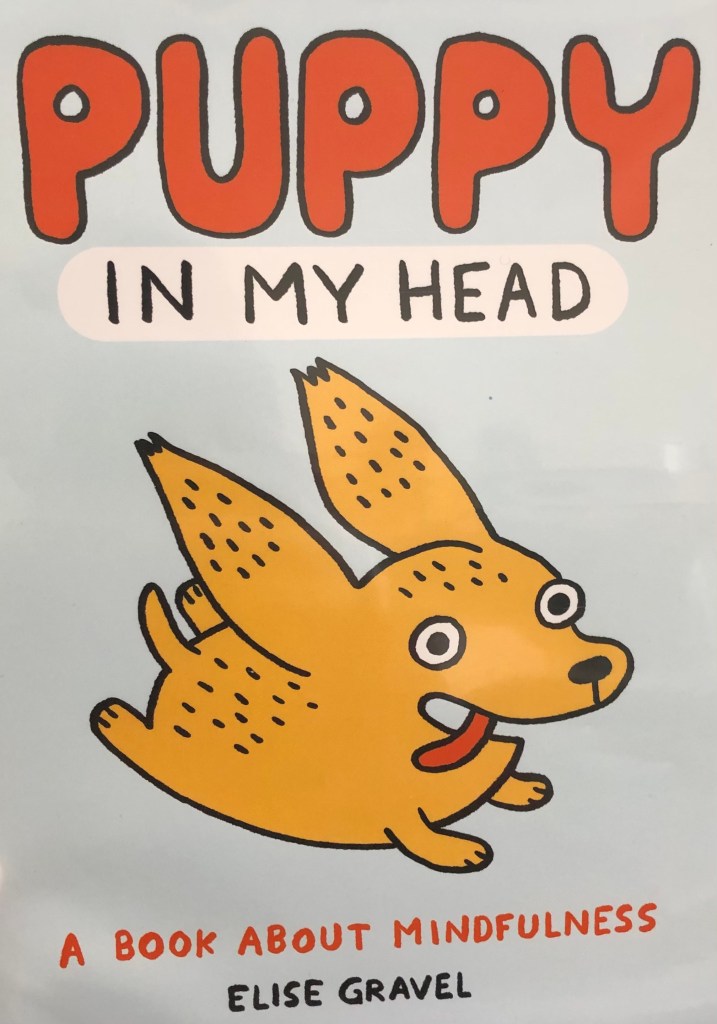
Cover of Book Puppy in My Head: A Book About Mindfulness by Elise Gravel
Puppy in My Head: A Book About Mindfulness by Elise Gravel
Wonderful author and illustrator Elise Gravel cleverly uses a puppy metaphor to teach young children how to identify and cope with anxiety. Mindfulness is the practice of being self aware of your emotional and physical state. Learning mindfulness is important for all ages, including adults. The practice involves breathing methods, guided imagery, and other useful tools that lead the practitioner reduces stress, relax and have a better sense of self at any given moment.
In the book, the reader is introduced to the puppy of the main character who lives in her head. This puppy manifestation runs around and is essentially all over the place as one can expect from a puppy, gets into mischief, and can sometimes get scared. However, there are some ways to help the main character helps guide the puppy when things get out of hand. Perhaps the reader can also relate to having a puppy in their head.
This delightful book, decorated in comic-style format, includes bright adorable images. The metaphor is simple enough for young children to understand the basic idea of what is being discussed without having to have a full cognition of anxiety making it a great teaching tool.
Request at your local library!
Bibliography Gravel, E. (2021). Puppy in My Head: A Book About Mindfulness (Illustrated ed.). HarperCollins.
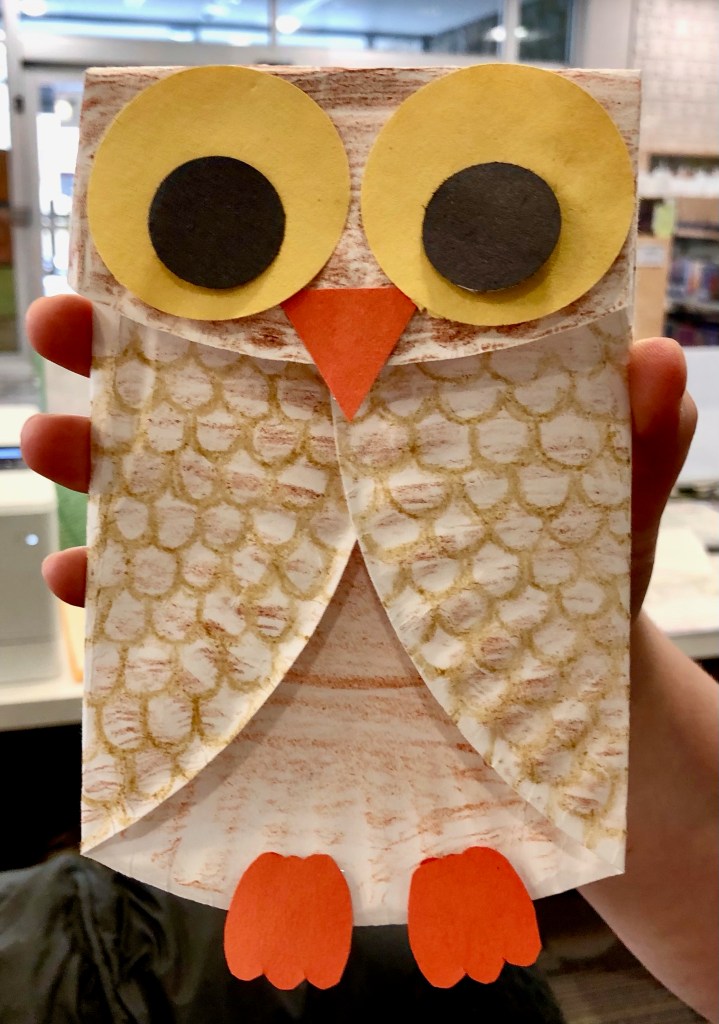
Picture of a completed Owl Craft used for a Take and Make Craft
The “Take and Make” crafts have been by far the most popular program since the start of the Covid-19 pandemic and I have to say the idea is brilliant. One of the challenges during the Covid-19 pandemic for children’s librarians is finding creative ways to teach and entertain children without the luxury of in-person activities. The online story times and other programs over Zoom can capture the children’s attention up to a certain point, but let’s face it, there is really no replacement for socially interacting with others in real life. So what can be done about it? The library staff decided to create a new program that would include craft projects that children could work on at home either on their own, during specific storytimes, or with their families. These craft projects include a bag filled with supplies, directions, and often a QR code for a video instructions. The crafts are then picked up curbside by those who signed up for one. Many of the crafts follow a holiday or season theme such as Lunar New Year or Presidents Day.
The Take and Makes have grown to be so popular, they are picked up around once or twice a week and as many as ninety orders have been made per craft project. The sign up sheets filled up so fast that new rules had to be set in place in order for all patrons to have an equal opportunity to sign up for their children. At this point I was asking myself “But really though, what makes these crafts so popular? Are the projects themselves extra spectacular?” After careful inspection, the crafts themselves are cute, but most of them are simplistic and ordered affordably on the site Oriental Trading. They’re made up of materials such as construction paper, ink stamps, sparkles, pompoms…you know, typical children’s crafts resembling what I made back in my kindergarten days. Which when I think about it, is exactly what these children need. These crafts are a fun, no-pressure activity that include tangible materials they can play with while also connecting with others whether it be with family members at home, or other children online during the online craft-included storytime program.
From an educational standpoint, crafts are an excellent tool for developing fine-motor skills, reading and following instruction, and broadening creativity and imagination. According to Co-creating with children: Arts and Crafts Toys by Hilde Smits, crafts as a children’s activity has the benefit of having educational value and being a creative outlet. Due to the structured nature of crafts, children crafting will develop an increase in cognitive skills such as when facing decisions about shape or details of their project. They experiment with tools, materials and learn to solve problems that might occur. Another great benefit of this activity is increasing family bonds through mutual activity. It is common for parents/guardians to assist their child through the process of building a craft and older siblings will help their younger siblings if they complete theirs first. Children learn to share and collaborate, increasing their social skills.
Although it is great that these crafts are helping children in their development, the truth is these crafts are flying off the shelves simply because the children love them, enjoy working with their hands during a time when they are stuck mostly indoors, isolated, and oversaturated with Zoom screens. It’s a very innovate idea that has kept children interested in their local library despite these crazy pandemic times.
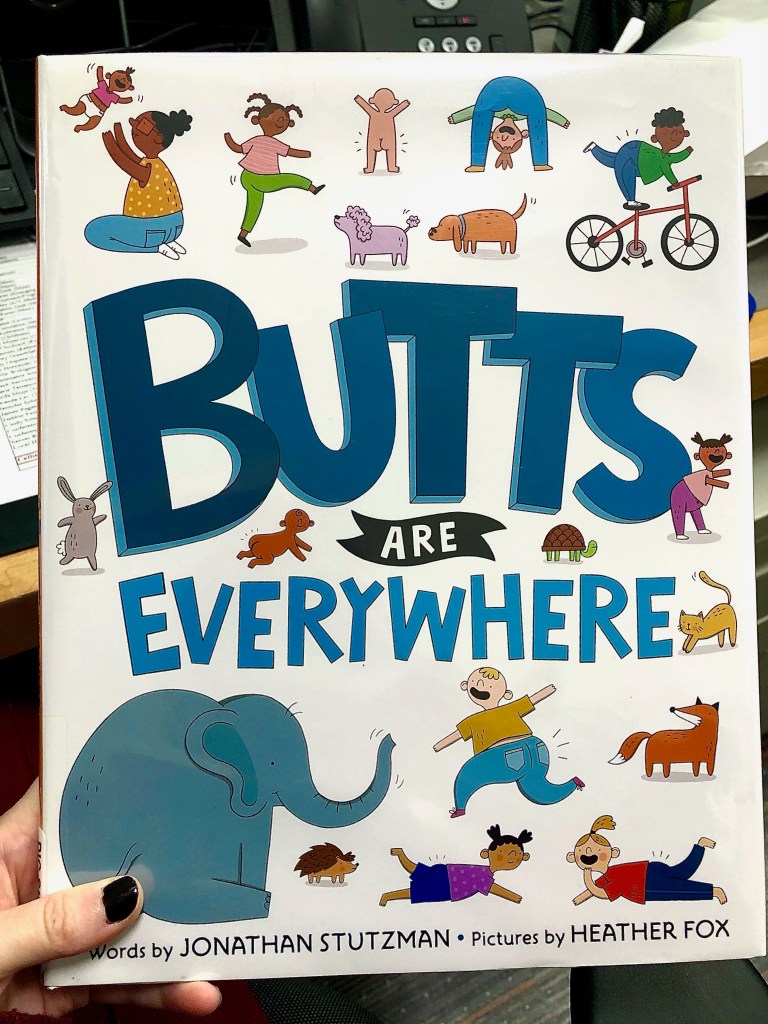
Picture of Book Cover of Butts are Everywhere by Jonathan Stutzman
The head of the Children’s Department where I was interning had started collaborating with on of the local schools to do story time online. Over Zoom she was able to read aloud three different picture book stories to the whole class of children. As she read the children clapped and those familiar with the stories happily shouted their favorite parts along with her. When all was done and she clicked out of Zoom, I was surprised to have her turn to me and politely apologize for her choice in books, “I don’t know, I just really like the silly ones.” They were all really great books. The books she choose to read were Pete the Cat I Love My White Shoes written by Eric Litwin, Ducks Don’t Wear Socks by John Nedwidek, Llama Destroys the World by Jonathan Stutzman. And most importantly, the children loved them. So what was she apologizing for? Yes that’s right. They were children’s books and they were silly… Silly? But, isn’t that what children’s books are supposed to be?
It does bring up an interesting point- should children’s books be silly? I quickly learned that this is a consistent topic discussed amongst children librarians. There are some who believe children’s literature should have a more serious tone. It is important to note that there the scope of Children’s literature is existence is vast and provides books written in many different styles and tones. There is no shortage of either silly or serious children’s literature. The question is if silly books are good for children? According to the article “Laughter and Learning: Humor Boosts Retention” by Sarah Henderson, humor is a great teaching tool for children scientifically. When laugher occurs it results in an increase in the the brain’s dopamine levels. The dopamine levels in the brain subsequently stimulates the part of the brain that controls goal-oriented motivation and long-term memory. Henderson believes the contagious nature of laughter benefits children’s sense of community, lowering their defenses and strengthening their connectivity with others. That’s not to say that being silly without reason is as effective as being silly with purposeful intent. If the humor being used doesn’t apply to the lesson, it will not be as effective at instilling the lesson into the children’s memory. In the book Pete the Cat I Love My White Shoes, Litwin’s main character Pete the Cat sings a song about walking in his white shoes and the various terrain he crosses that leads to his white shoes turning different colors. The book uses songs with silly lyrics to encourage children to sing along or remember the answers to the question of what color his shoes will turn depending on what Pete steps in. The lesson is simple sculpting an image of how the world interacts such as if you step in mud your shoes will turn brown or if you step in water the mud will wash away but then water will also make your shoes wet.
Humor as a tool is also a great way to help children relax and open up to problems they may be struggling with. Developmental psychologists believe humor can be used as a way to help discuss difficult topics with children, topics that may be scary, painful, or overwhelming by nature. According to “Chapter 8: Humor and Developmental Psychology” from the book The Psychology of Humor by Rod A. Martin, humor is a technique that enables children to deal with stressful situations and topics. Rather than feeling threatened and anxious by the idea of death, violence, punishment, bodily functions, sexuality and stupidity, a child’s laughter will put them at ease and allow them to accept and face the issue, resulting in a sense of mastery. The book Llama Destroys the Universe is a great example of how this works. Stutzman writes about a llama who destroys the universe by accidentally ripping his pants that also rips the fabric of space and time. Environmental doom is currently a hot topic. Young children are bound to hear at some point or another about Global Warming or other similar concepts that can often cause overwhelming anxiety, even amongst adults. Here, Stutzman uses humor through use of modern lingo and overly dramatized events to help children cope with the topic of environmental doom, inadvertently teaching concepts such as learning to accept reality as is and that life still goes on despite circumstances beyond their control.
What I find best about seriously silly books is what seems the most obvious to me, children love them. To a librarian, the most important part of storytime is inspiring children to read more. I would agree with the belief that not all children’s literature should be humorous. However, silly books are a great way to wet the child’s appetite for more books. If the children love the books read to them, they will inevitably want to read more whether it be more books from the same series, by the same authors, about the same topics, etc. When my supervisor read the books she choose for her storytime, the chilldren laughed at all the jokes, shouted in unison to the words of the books they knew, and cheered at the end of each story. This story time was an amazing success. According to the article “Using Storytelling to Improve Literacy” published on the University of Texas at Arlington Academic Partnerships, storytimes are essential for improving all areas of literacy learning. It helps children learn about other, promotes positive feelings regarding reading, develops better listening skills, encourages the imagination and creativity, and demonstrates language use and story structure. This is especially true with stories that truly connect with the children and engages their interests such as silly stories. When children are happily involved with a story that draws them thanks to the humorous aspect of the book, their literacy skills increase. They are listening carefully, speaking loudly, and communicating with confidence.
The truth of the matter is Children’s literature sometimes include books that are over-the-top, super, ridiculously silly, and yet, this does not mean that the purpose of the book is simply to be silly. Even silly books use humor for a reason, whether it be to help children remember lessons, cope with stressful ideas, make them feel more socially at ease, develop a taste for reading, or better engage them with the story. There are so many ways in which silly stories benefit children, it would be impossible to cover them all. However, like many genre books, people have a tendency to look down on them without looking for a deeper meaning. Silly books are just as serious as they are silly, and there is nothing wrong with that. In the book “Duck’s Don’t Wear Socks”, Nedwidek writes about a girl named Emily who prefers to view the world from a serious perspective but after crossing a silly duck who likes to wear socks and challenge the status quo of what is appropriate for a duck to do, she learns that sometimes its okay to not be serious all the time and instead to have fun and be…silly! In the case of whether children’s literature should always be serious, I am inclined to agree with the duck.
Bibliography
Dean, J., & Litwin, E. (2010). Pete the Cat: I Love My White Shoes (1st ed.). HarperCollins.
Martin, R. A., & Ford, T. (2007). Chapter 8: Humor and Developmental Psychology. In The Psychology of Humor: An Integrative Approach (pp. 229–268). Academic Press.

 Shelf Adulation