Whenever I do a Storytime with children, I always try to include an activity that connects the with the theme of the books read in Storytime. These activities will really help bring the stories to life while also adding in an extra bit of fun and learning associated with reading. One example is when I read two books about saltwater animals, one nonfiction about clownfish and another fiction book about seahorses. Afterwards, the children and I discussed how salt water is different from regular water. We discussed it’s different attributes, where it can be found on Earth, what it’s used for, the different marine creatures that live in it, and more. I then did a simple science experiment with where we wanted to see if different items would float or sink differently in salt water compared to regular water. I used two plastic cups filled with plain tap water and added salt to one of the cups. Then we added a marshmallow in each cup, a rock in each cup, and last an egg in each cup. The children were so suprised to see the egg sink in plain water but float in regular water. We discussed the science behind it. This activity only took about 8 minutes and was really thrilling for the children who were ages 3-6 years old. Other activities I have done with them includes performing the books, dancing, playing games, crafts, and so many others. Not all activities were that interesting to the children but most have been successes! I’d suggest taking about 10 minutes when reading a book to your child to think up a fun way to really make the book come to life for them and tie it into the world around them. They’ll absolutely love it!
Baby Steps
What one must realize about children’s librarians, is that they are the only public librarians that deal with people of all ages. Although the services are centered around children, programs are often run with family service in mind, by trying to build family ties and provide guidance for caretakers. One perfect example of this is Baby Time. What may be viewed as a fun fluff entertainment activity for babies, this program is in reality designed with the intention of helping parents learn how they may help with their baby’s development.
Baby Time is set up with parents in a circle on the floor while holding their babies. The librarian is joined with the parents in the circle, holding a baby-sized stuffed animal as their “baby” for demonstrative purposes. The librarian then instructs the parents through different interactive motions with their baby while often singing to traditional appropriately-aged songs.
It is important to explain to the parents the importance of what they are doing. This is a great time to incorporate some child-development jargon such as “by helping clapping your baby’s hands together, you are helping them develop their motor skills” or “now let’s all let our baby’s crawl towards the center of the circle and let them socialize with their peers”.
According to the article “4 Ways to Encourage Motor Development in Baby’s First Year” expert Lindsay Pietruszewski, PT, DPT, who is a physical therapist at Nationwide Children Hospital’s Main Campus writes that a baby will develop critical motor skills that will enable their ability to make small movements including holding up their head, sitting up-right, and crawling eventually leading to walking. With these activities, caregivers can help accelerate the development of bones and muscles that help them achieve these milestones.
What’s so great about these activities is that they are often activities parents are already doing on their own. This program helps reaffirm to the parents that what they are doing at home with their babies is actually good parenting. However, you may want to directly say this to the parents and encourage them to keep up these activities whenever possible.
One of the additional benefits of Baby Time for parents is meeting other parents with babies their same age. It can be hard for new time parents to find friends while taking care of a baby at the same time. This provides them with an opportunity to find friends with people who will understand the importance of the developmental milestones that their baby will achieve.
Lastly, be sure to allow time at the end of the session to have any of the parents or caregivers ask you questions one-to-one. Since you are not a professional child developmental psychologist, you may not know the answer to their questions, but you may be able to help them find the answers or find a professional who might be able to help them.
Bibliography
Pietruszewski, L. (2020, July 9). 4 Ways to Encourage Motor Development in Baby’s First Year. Nationwide Childrens. https://www.nationwidechildrens.org/family-resources-education/700childrens/2020/07/4-ways-to-encourage-motor-development-in-babys-first-year
Nightmare on 741.5 Street Resolved
For those who may be curious about what happened to the graphic novel section of the library I’m interning at, after many weeks and a multitude of meetings later, there is finally a resolution to the madness. To recap, the debate was how the graphic novel section specifically in the Children’s department are to be organized…by title or author?
One question to consider is should the novels be easier for the librarians to find for patrons or for patrons to browse for themselves? Some graphic novels are better known for their titles whereas some are better known for their titles. Librarians are often more familiar with the authors of books they are finding for patrons and despite having a library catalogue for reference, this takes time. The less time it takes for a librarian to find a book, the better quality customer service they can provide. This is essential in an industry where the products are free and thus patron satisfaction is how a libraries keep their patrons supporting the library.
On the other hand, ease of accessibility of materials for the public is a fiercely protected mantra of the library science field. Although there are a few graphic novel authors who stand out, many graphic novel readers look for graphic novels via titles. Then there are graphic novel series to consider, which are often written by many different authors but are all under the same title or series.
If you are wondering how it is usually done at other libraries, the answer is both. According to the experience of my peers who have worked in various different public libraries, some organize graphic novels by title whereas some organize by author. So there is no “right way” to do this, only the way that specific library feels is best for their library and community. Finally, however, there was an agreement made. Taking both parties best interests into account, the department head decided to organize graphic novel series by their series title and stand alone graphic novels by author.
This might be considered to be a controversial decision that disrupts the integrity of library organization methodology due to its lack of consistency. However, for those open to bending the rules depending on the situation, this is actually a great option to consider. What really matters here is having the needs of both librarians and patrons met. This means that popular stand-alone books that are being requested by author will be found quickly and efficiently. Simultaneously, book series will be able to remain together in number order so patrons will be able to find the next one they are looking for with ease.
So what next? With the final decision made, all graphic novels have to be taken into tech services where the new call numbers for each book will be adjusted in the catalogue, new call number stickers will be added to the books, and returned to be re-shelved alphabetically according to call number. I had the pleasure of writing a record of the different call number changes as a reference guide for the other library branches to follow since all of the different branches have to be synchronized with the main branch. Once the list is complete, it will be sent to them so they can make the same changes to their graphic novel collection.
Book Recommendation: Please Open This Book!

Please Open This Book! by Adam Lehrhaupt
This book was suggested to me as a great storytime read and I have to agree! The book starts by breaking the fourth wall with cartoon animals in the book thanking you for opening the book. They have bandages on demonstrating the side effects of what happened the last time the book was closed on them. Their gratitude quickly turns into horror as they realize that with each page turn the reader will eventually close the book on them again and they begin to plea that you won’t…but of course we all know how this ends.
The story is written with comedic dramatics and illustrated with equally as such. The book is fast to read through and gets funnier with every page. We’ve all seen this don’t-keep-turning-the-pages routine in some children’s literature, but this book uses it in a way that is especially cute.
This book can be used for a various age range. It is a very quick read and makes the
readers think of books as an item and not simply a story, and therefore must be old enough to grasp this concept. My estimate would be about preschool to possibly second grade.
Bibliography
Lehrhaupt, A., & Forsythe, M. (2015). Please, Open This Book! (Illustrated ed.). Simon & Schuster/Paula Wiseman Books.
New Book: The Snow Dancer
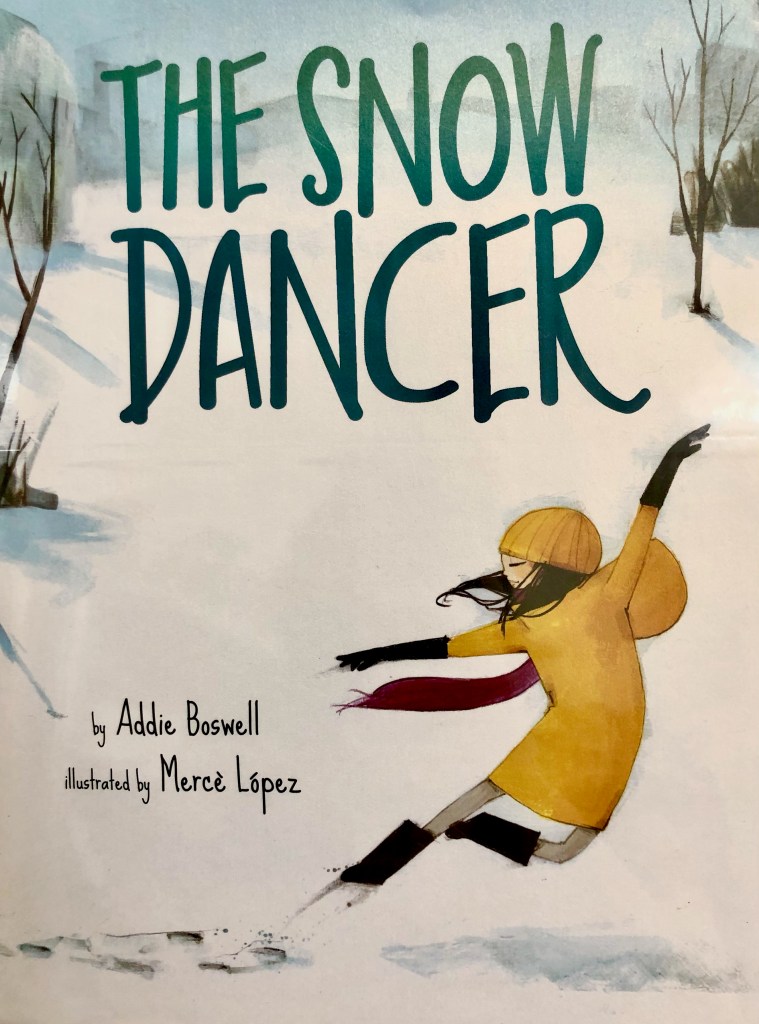
The Snow Dancer by Addie Boswell
Need a book for the young ones to curl up to on a cold, snowy day? Search no further, this is the book! What are you going to do if you wake up to find fresh snow on the ground yet to be touched? Why dance in it, of course!
This book tells a tale of a girl who becomes one with the wind and snow as she dances leaving a trail in the snow that records her movements. Unfortunately, she soon faces a problem when other children arrive to play in the snow, too, who don’t seem to understand her or her dance. She must learn to share the snow and play with them, but what of her dancing?
This tale is elegantly written and is perfect for a winter or dance themed storytime. The story uses third-person narration and tasteful illustrations to capture the beautiful movements of dance, as well as, the passion that comes from connecting with nature. Would be perfect for children around second grade.
Bibliography
Boswell, A., & López, M. (2020). The Snow Dancer. Two Lions.
Book Recommendation: I’m the Biggest Thing in the Ocean
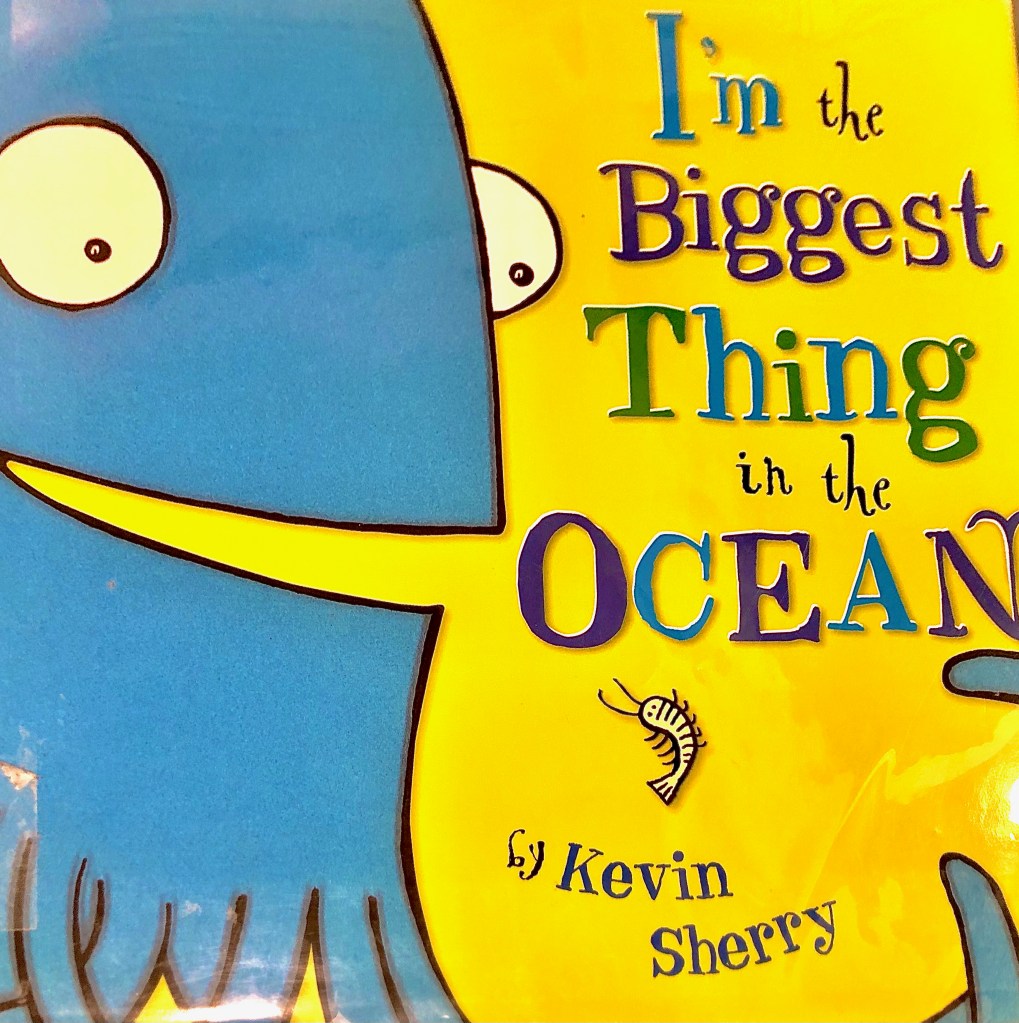
I’m the Biggest Thing in the Ocean by Kevin Sherry
This is a very cute book, great for a fun laugh. In this book, the reader is spoken to directly by a giant squid who believes it is the largest creature in the ocean. The giant squid then demonstrates this theory by pointing to different types of creatures it passes and verifying their smaller size. However, the giant squid will soon discover that, well, perhaps it is not the biggest creature.
The story is quick to read through and is bound to get a smile on the children’s faces. The story is good at covering the different type of animals that live in the ocean, though it does not go into detail about the animal.
This would be great for an ocean or animal themed storytime. The wording is simplistic and uses imagery to explain plot such as the comparing of animal sizes and the twist ending. Would be great for toddlers and up.
Bibliography
Sherry, K. (2010). I’m the Biggest Thing in the Ocean! (Brdbk ed.). Dial Books.
New Book: There Must be More Than That!
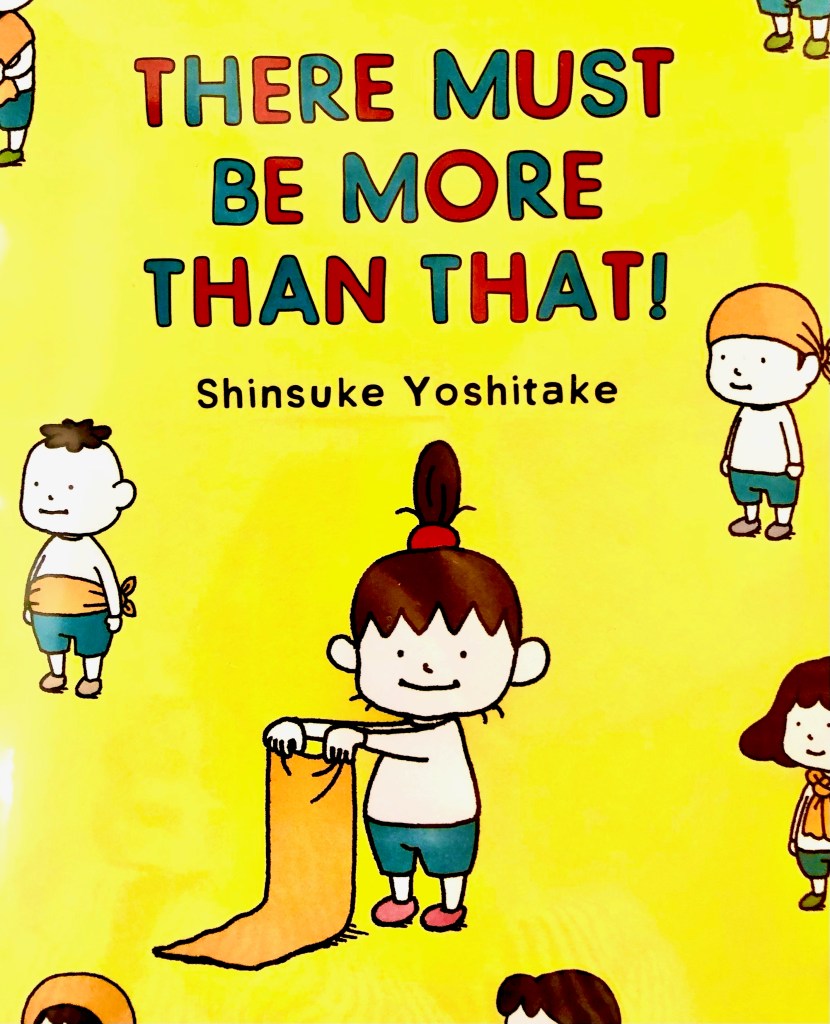
There Must Be More Than That! by Shinsuke Yoshitake
Children today sometimes overhear adults bring up doomer philosophy, whether intentional or not. This can be very stressful for them to hear and difficult to process. So what do you do if your older brother tells you that there will be no future when you grow up? Thanks to a talk with your wise grandma, you learn about the possiblity of multiple futures! What a neat trick, huh? When the main character learns this, the reader then follows her throughout the house as she explains to each family member the infinate possible futures that can occur and even persuades her brother that nothing is ever written in stone.
The story manages to take the power away from something as scary as the future and instead turn it into a tool to empower the reader. The author includes creative and funny future possibilities intermixed with realistic future possibilities, causing the reader to laugh while also taking the lesson seriously. The images are in a modern-cartoon style that looks particularly cute and endearing.
I would not suggest this book to be a used as a storytime due to the images being scattered throughout the pages in almost a comic-like design as well as its multitude of sentences and words on each page. However, it is not impossible to use for a storytime for those who enjoy a bit of a challenge. Great for second and third graders.
Bibliography
Princess Arabella at the Museum by Mylo Freeman
New Book: Princess Arabella at the Museum
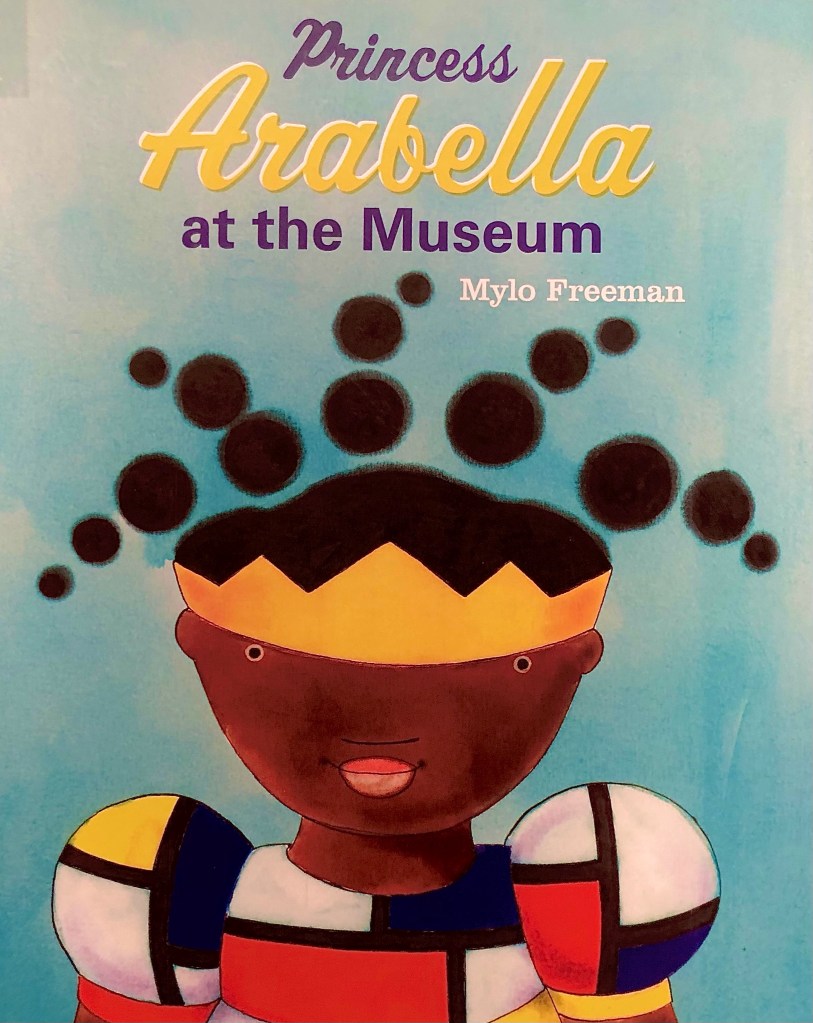
Princess Arabella at the Museum by Mylo Freeman
This is a great book for art lovers! When Princess Arabella, a young black princess, tells her royal friends that she has created a museum, they all line up to see what all the fuss is about. Once inside, they’re view of the world is challenged by Princess Arabella’s artworks. She teaches them concepts of perspective, thinking outside the box, and that art can be just about anything!
It features art that is inspired by Yayoi Kusama’s dotted pumpkins, Louise Bourgeois’ Maman, Jeff Koons’s balloon animal sculptures, and others. There’s a message of art being for everyone, regardless of race or background. Princess Arabella’s love for art is pure, her friends can see that too and they become inspired to create their own art.
The story is not a fast but worth the read through. This book would make for a great storytime reading. For fast readers, a little time between pages for the children to see the artworks might be desirable to create the full experience of the book, almost as though you are actually at a museum.
Bibliography
Freeman, M. (2021). Princess Arabella at the Museum. Cassava Republic Press.
New Book: Sunny-Side Up
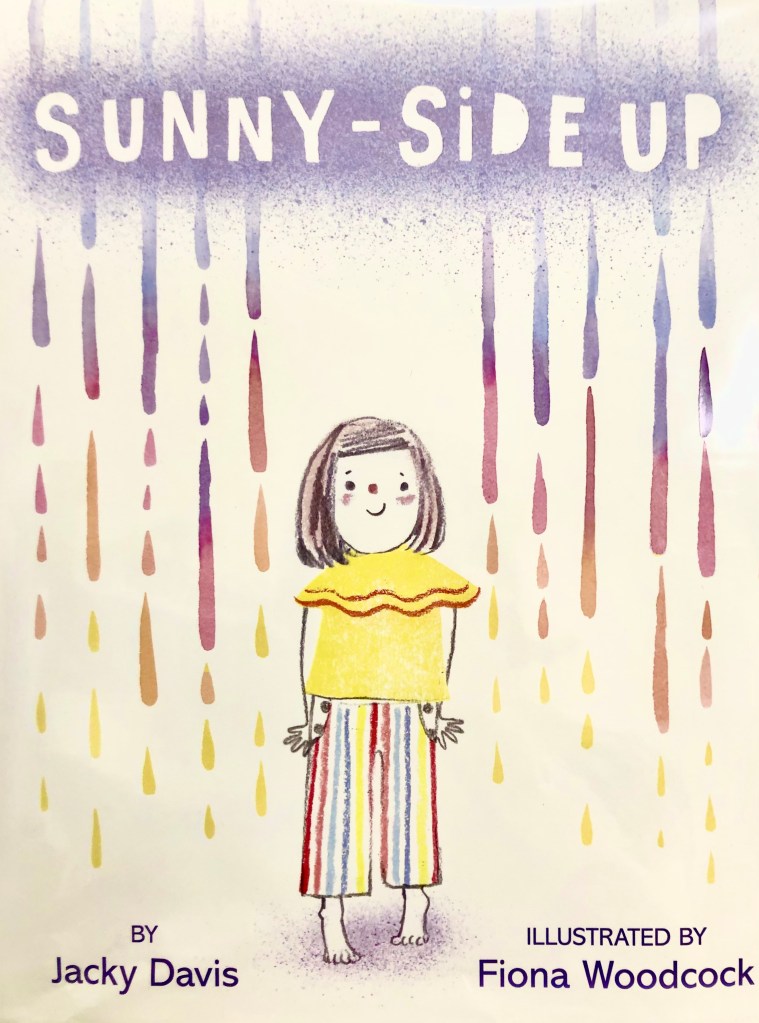
Sunny-Side Up by Jacky Davis
A great read for a rainy day! This darling book reveals the fun times that can be experienced when playing indoors due to bad weather. The reader follows the day of a little girl who explains her frustration at having to have to change her plans and play inside when she sees there is rain outdoors. She soon realizes that there are fun activities she can still do and with a little imagination and creativity, she finds herself on fun adventures still.
There is a clear message of learning to accept what you can’t change and make the best of it regardless. This is a serious-toned book written in the first person of the little girl and her thought process. The pages are visually calming with softly colored backgrounds.
I would suggest using this book for storytimes centered around a theme of water, rain, weather, using your imagination, or learning to cope with emotions. This is a wonderful book for young children around the age of preschool.
Bibliography
Davis, J., & Woodcock, F. (2021). Sunny-Side Up. Greenwillow Books.
Storytime Book Recommendation : Avocado Asks
Avocado Asks: What am I? by Momoko Abe
Avocado is chilling in the produce section of the supermarket when a young customer asks if avocado is considered a fruit or a vegetable. This question stumps avocado who has no idea what type of food it is, spirals into a full on identity crises resulting in Avocado journeying through all sections of the supermarket looking for the answer.
For anyone who has at some point felt like they didn’t know where they belonged and developed a sense of confusion, anxiety or frustration from it, this book is for them. Without spoiling the entire book, all I can say is the author uses a thinly veiled metaphor to discuss the question of fitting in that can (but don’t have to) be applied to many different social connotations such as gender, multi-racial, and/or multi-cultural identity. The author uses humor as a technique to discuss a potentially stressful topic with children. The story provides examples of how others may be un-empathetic towards an internal struggle, while others will be there to help along the way. The colorful images tie into the storyline by supporting the silly tone of the book.
The story also provides a secondary function of providing a breakdown of the different food types, what they are and their descriptions. Of course, this then ties in with yet another lesson which not everything will be definable. This book goes beyond the concept of labels challenging the reader not to expect everything or everyone to fit into a category.
This book is a picture book that is great for storytime because the humor is enjoyable for all ages, easy to read at a quick pace, and the illustrations are large and clear. It promotes self-acceptance, tolerance, and perspective. Although the reading level is simple and would be better targeted for younger ages, I’ve seen it used for storytime for as old as 2nd grade with success.
Request this book from your local library!
Bibliography
Abe, M. (2020). Avocado Asks: What Am I? Orchard Books.
Amazon Link
https://www.amazon.com/Avocado-Asks-What-Am-I/dp/1408358220
 Shelf Adulation