The head of the Children’s Department where I was interning had started collaborating with on of the local schools to do story time online. Over Zoom she was able to read aloud three different picture book stories to the whole class of children. As she read the children clapped and those familiar with the stories happily shouted their favorite parts along with her. When all was done and she clicked out of Zoom, I was surprised to have her turn to me and politely apologize for her choice in books, “I don’t know, I just really like the silly ones.” They were all really great books. The books she choose to read were Pete the Cat I Love My White Shoes written by Eric Litwin, Ducks Don’t Wear Socks by John Nedwidek, Llama Destroys the World by Jonathan Stutzman. And most importantly, the children loved them. So what was she apologizing for? Yes that’s right. They were children’s books and they were silly… Silly? But, isn’t that what children’s books are supposed to be?
It does bring up an interesting point- should children’s books be silly? I quickly learned that this is a consistent topic discussed amongst children librarians. There are some who believe children’s literature should have a more serious tone. It is important to note that there the scope of Children’s literature is existence is vast and provides books written in many different styles and tones. There is no shortage of either silly or serious children’s literature. The question is if silly books are good for children? According to the article “Laughter and Learning: Humor Boosts Retention” by Sarah Henderson, humor is a great teaching tool for children scientifically. When laugher occurs it results in an increase in the the brain’s dopamine levels. The dopamine levels in the brain subsequently stimulates the part of the brain that controls goal-oriented motivation and long-term memory. Henderson believes the contagious nature of laughter benefits children’s sense of community, lowering their defenses and strengthening their connectivity with others. That’s not to say that being silly without reason is as effective as being silly with purposeful intent. If the humor being used doesn’t apply to the lesson, it will not be as effective at instilling the lesson into the children’s memory. In the book Pete the Cat I Love My White Shoes, Litwin’s main character Pete the Cat sings a song about walking in his white shoes and the various terrain he crosses that leads to his white shoes turning different colors. The book uses songs with silly lyrics to encourage children to sing along or remember the answers to the question of what color his shoes will turn depending on what Pete steps in. The lesson is simple sculpting an image of how the world interacts such as if you step in mud your shoes will turn brown or if you step in water the mud will wash away but then water will also make your shoes wet.
Humor as a tool is also a great way to help children relax and open up to problems they may be struggling with. Developmental psychologists believe humor can be used as a way to help discuss difficult topics with children, topics that may be scary, painful, or overwhelming by nature. According to “Chapter 8: Humor and Developmental Psychology” from the book The Psychology of Humor by Rod A. Martin, humor is a technique that enables children to deal with stressful situations and topics. Rather than feeling threatened and anxious by the idea of death, violence, punishment, bodily functions, sexuality and stupidity, a child’s laughter will put them at ease and allow them to accept and face the issue, resulting in a sense of mastery. The book Llama Destroys the Universe is a great example of how this works. Stutzman writes about a llama who destroys the universe by accidentally ripping his pants that also rips the fabric of space and time. Environmental doom is currently a hot topic. Young children are bound to hear at some point or another about Global Warming or other similar concepts that can often cause overwhelming anxiety, even amongst adults. Here, Stutzman uses humor through use of modern lingo and overly dramatized events to help children cope with the topic of environmental doom, inadvertently teaching concepts such as learning to accept reality as is and that life still goes on despite circumstances beyond their control.
What I find best about seriously silly books is what seems the most obvious to me, children love them. To a librarian, the most important part of storytime is inspiring children to read more. I would agree with the belief that not all children’s literature should be humorous. However, silly books are a great way to wet the child’s appetite for more books. If the children love the books read to them, they will inevitably want to read more whether it be more books from the same series, by the same authors, about the same topics, etc. When my supervisor read the books she choose for her storytime, the chilldren laughed at all the jokes, shouted in unison to the words of the books they knew, and cheered at the end of each story. This story time was an amazing success. According to the article “Using Storytelling to Improve Literacy” published on the University of Texas at Arlington Academic Partnerships, storytimes are essential for improving all areas of literacy learning. It helps children learn about other, promotes positive feelings regarding reading, develops better listening skills, encourages the imagination and creativity, and demonstrates language use and story structure. This is especially true with stories that truly connect with the children and engages their interests such as silly stories. When children are happily involved with a story that draws them thanks to the humorous aspect of the book, their literacy skills increase. They are listening carefully, speaking loudly, and communicating with confidence.
The truth of the matter is Children’s literature sometimes include books that are over-the-top, super, ridiculously silly, and yet, this does not mean that the purpose of the book is simply to be silly. Even silly books use humor for a reason, whether it be to help children remember lessons, cope with stressful ideas, make them feel more socially at ease, develop a taste for reading, or better engage them with the story. There are so many ways in which silly stories benefit children, it would be impossible to cover them all. However, like many genre books, people have a tendency to look down on them without looking for a deeper meaning. Silly books are just as serious as they are silly, and there is nothing wrong with that. In the book “Duck’s Don’t Wear Socks”, Nedwidek writes about a girl named Emily who prefers to view the world from a serious perspective but after crossing a silly duck who likes to wear socks and challenge the status quo of what is appropriate for a duck to do, she learns that sometimes its okay to not be serious all the time and instead to have fun and be…silly! In the case of whether children’s literature should always be serious, I am inclined to agree with the duck.
Bibliography
Dean, J., & Litwin, E. (2010). Pete the Cat: I Love My White Shoes (1st ed.). HarperCollins.
Henderson, S. (2015, March 31). Laughter and Learning: Humor Boosts Retention. Edutopia. https://www.edutopia.org/blog/laughter-learning-humor-boosts-retention-sarah-henderson
Martin, R. A., & Ford, T. (2007). Chapter 8: Humor and Developmental Psychology. In The Psychology of Humor: An Integrative Approach (pp. 229–268). Academic Press.
Nedwidek, J., & White, L. (2008). Ducks Don’t Wear Socks. Viking Juvenile.
Stutzman, J., & Fox, H. (2019). Llama Destroys the World (A Llama Book, 1). Henry Holt and Co. (BYR).
Using Storytelling to Improve Literacy. (2015, December 10). UTA Online. https://academicpartnerships.uta.edu/articles/education/using-storytelling-to-improve-literacy.aspx
Links to seriously silly Children’s literature mentioned in text:
Pete the Cat: I Love My White Shoes by James Dean and Eric Litwin
Link: https://www.amazon.com/Pete-Cat-Love-White-Shoes/dp/0061906220
Ducks Don’t Wear Socks by John Nedwidek
Link: https://www.amazon.com/Ducks-Dont-Wear-Socks-Nedwidek/dp/0670061360
Llama Destroys the World by Jonathan Stutzman
Link: https://www.amazon.com/s?k=llama+destroys+the+world&i=stripbooks&crid=2GLM52E13MFIA&sprefix=llama+destroys%2Cstripbooks%2C164&ref=nb_sb_ss_ts-doa-p_1_14
Links to even more seriously silly Children’s literature:
Avocado Asks: Who am I? by Momoko Abe
Link: https://www.amazon.com/Avocado-Asks-What-Am-I/dp/1408358220
The Book With No Pictures by B. J. Noval
Link: https://www.amazon.com/Book-No-Pictures-B-Novak/dp/0803741715
The Very Impatient Caterpillar by Ross Burach
Link: https://www.amazon.com/Book-No-Pictures-B-Novak/dp/0803741715
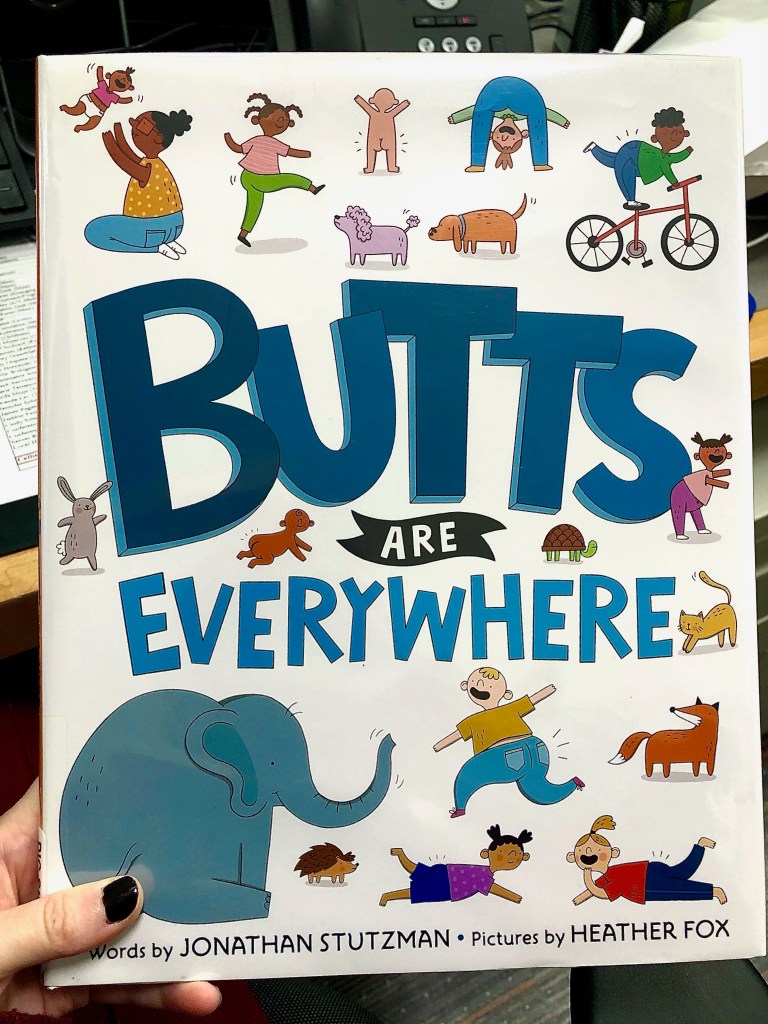
Butts Are Everywhere by Jonathan Stutzman
Link: https://www.amazon.com/Butts-Are-Everywhere-Jonathan-Stutzman/pd/0525514511
 Shelf Adulation